Wednesday, May 22, 2013

Unit 1 Day 5: Similar figures: What are they and finding the missing length.


Objective:  Learn about similar figures and how to find the missing length on one side.

Similar Figures: Two figures that have the same shape but are not necessarily the same size.
These two triangles above are similar triangles. The smaller one is half the size of the larger one. 
 
These two triangles are also similar but as you can see there is a side missing. To find this missing side we can use proportions. Take two of same side from each and put it into a proportion. We will use 10 and 7 from the smaller triangle and 20 and the missing value x. Put this into a proportion of 10/7 and 20/x solve and you will find that x= 14. You can also do it easy to see if the other values are half of the larger on if so then it will be easy to do the math and multiply the small number by two.

Questions:

1.) Find the missing side length.

2.) Find missing value.
3.) Find missing value.


Answers: 

1.) 6/9 = 14/x
9x14/6= 21

2.) 18/21= 6/x
21x6/18= 7

3.) 3/4 = 9/x
4x9/3= 12
5/4 = x/12
5x12/4= 15

Monday, May 20, 2013

Unit 1 Day 4: Surface area of prism, pyramid, cylinder, cone, sphere in the real life (not fake life).

Objective: Surface area of prism, pyramid, cylinder, cone, sphere in the real life (not fake life).

We use surface area when we need to paint a house on the outside. We need to know how many gallons of paint to get. If you want to be a chemist when you are older and you are mixing elements, the larger the surface area the faster it will react. Dentists also use surface area when determining the size of dental restoration. You will need to know surface area even if you never have a job. When being a parent you need to know the surface area of a present to know how much wrapping paper you need.


Questions:
1. Name three jobs that require surface area. (not examples up top)

2. Name two thing that you can see that you think needed the surface area to make.

3. How do you know when to use surface area.

Answers:
1. Anything that makes sense.

2. Houses, cars, etc.

3. When you need to buy something like paint, etc.

Sunday, May 19, 2013

Unit 1, Day 3: Surface area of prism, pyramid, cylinder, cone, and sphere

Objective: Be able to find the surface area of a prism, pyramid, cylinder, cone, and sphere

Formulas:
Cube = 6s2
where s = length of the side
cube
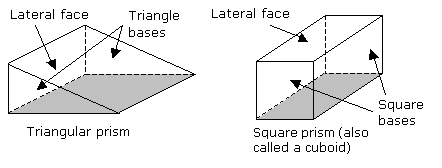
Prism =  2(lw + lh + wh)
where l = length, w = width, h = height

prism
Pyramid =  area of base + area of each of the lateral faces
 pyramid
Cylinder =  2πr (r + h)
where r = radius, h = height

Cone = πr (r + s)
where r = radius, s = slant height
 
Sphere =  4πr2
where r = radius 


Questions: 
1.) Find the surface area of the triangular prism below.
2.) Find the surface area of the sphere below.


3.) Find the surface area of the cylinder below.


Answers:

1.) 4•3=12  12÷2=6  6•2=12
7•3=21 7•4=28 5•7=35    35+28+21+12=96ft squared

2.) 18•18=324  324•4=1,296  1,296•π=4,071.5units squared

3.) 2•π•6=37.69  37.69•22=829.38" squared

Unit 1, Day 2: Introduce concept of scales (dilations)

Objective: Introduction on concept of scales and review from day 1.


Scale Factor


Definition of Scale Factor
  • The ratio of any two corresponding lengths in two similar geometric figures is called as Scale Factor.
  • The ratio of the length of the scale drawing to the corresponding length of the actual object is called as Scale Factor.
More about Scale Factor
  • A scale factor is a number used as a multiplier in scaling.
  • A scale factor is used to scale shapes in 1, 2, or 3 dimensions.
  • Scale factor can be found in the following scenarios:
    1. Size Transformation: In size transformation, the scale factor is the ratio of expressing the amount of magnification.
    2. Scale Drawing: In scale drawing, the scale factor is the ratio of measurement of the drawing compared to the measurement of the original figure.
    3. Comparing Two Similar Geometric Figures: The scale factor when comparing two similar geometric figures, is the ratio of lengths of the corresponding sides.

ABCD and PQRS are similar polygons. Then the scale factor of polygon ABCD to polygon PQRS is the ratio of the lengths of the corresponding sides.
  • Scale factor = BC:QR = 3:8.
Solved Example on Scale Factor
Find the scale factor from the larger rectangle to the smaller rectangle, if the two rectangles are similar.
Choices: 
A. 5:1
B. 5:6
C. 6:5
D. 6:7
Correct Answer: B
Solution:
Step 1: If we multiply the length of one side of the larger rectangle by the scale factor we get the length of the corresponding side of the smaller rectangle.
Step 2: Dimension of larger rectangle × scale factor = dimension of smaller rectangle
Step 3: 24 × scale factor = 20 [Substitute the values.]
Step 4: Scale factor = 20/24 [Divide each side by 24.]
Step 5: Scale factor =  = 5:6 [Simplify.]
Therefore, scale factor from the larger rectangle to the smaller rectangle is 5:6.


Questions: 

1. Find the image of point P (1, 2) under dilation with center (0, 0) with a scale factor of 2.
A. (- 1, - 2)
B. (2, 4)
C. (- 2, 4)
D. (2, - 4)


2. A map is constructed on a scale of 10 ft to 1 in. What is the area of the land represented on the map by an oblong measuring 4 × 5 in.?
A. 4000 ft2
B. 2000 ft2
C. 50 ft2
D. 2100 ft2

3. A map is constructed on a scale of 20 yd to 1 in. What is the area of the land represented on the map by an oblong measuring 3 × 2 in.?
A. 40 yd2
B. 2400 yd2
C. 4800 yd2
D. 2500 yd2


Answers:

1. Step 1 : To find the image of a point on the coordinate plane under dilation with center as origin, multiply the coordinates with scale factor.
Step 2 : Image of P (1, 2) is P ′(1 × 2, 2 × 2)
Step 3 : = (2, 4)

2.Step 1 : Scale = 10 ft to 1 in.
Step 2 : The actual width of the ground = 4 × 10 = 40 ft.
Step 3 : The actual length of the ground = 5 × 10 = 50 ft
Step 4 : So, the area of the land = 40 × 50 = 2000 ft2.

3. Step 1 : Scale = 20 yd to 1 in.
Step 2 : The actual width of the ground = 3 × 20 = 60 yd.
Step 3 : The actual length of the ground = 2 × 20 = 40 yd.
Step 4 : So, the area of the land = 60 × 40 = 2400 yd2.


Thursday, May 16, 2013

Unit 1, Day 1: Area of squares, rectangles, triangles, trapezoids, parallelograms, circles, and polygons. Define point, line, plane, line segment, ray, angle, median, altitude, perpendicular.

Objective: Area of squares, rectangles, triangles, trapezoids, parallelograms, circles, and polygons. Define point, line, plane, line segment, ray, angle, median, altitude, perpendicular.

Area:

square = a 2                                
rectangle = ab  
triangle = 0.5(b•h) [IMAGE]
parallelogram = bh 
trapezoid = h/2 (b1 + b2) 
circle = pi•r 2  
polygon = (0.5)(apothem)(perimeter)


Define: 
point = a precise location or place on a plane, usually represented by a dot

line = a geometrical object that is straight, infinitely long, and infinitely thin

plane = a two-demensional surface that you place lines, points, line segments, etc.

line segment = a part of a line connected to two points with definite ends

ray = a portion of a line which starts at a point and goes off in a particular direction to infinity

angle = the amount of turn between two straight lines that have a common endpoint (the vertex)

median = a line segment joining a vertex to the midpoint on the opposite side (a triangle has 3 medians)

altitude = another word for height

perpendicular = two lines that meet together at a 90º angle

Quiz: 

1.) Find the area of a parallelogram with the base of 8.6 in. and the height of 12.9 in.

2.) Find the area of a triangle with the triangle with a height of 15.2 in. and a base of 9.7 in.

3.) Find the area of a circle with radius of 3.1 cm.

4.) Find the area of a square with the sides being 9.32 in.

5.) Find the area of a rectangle with the sides being 3.8 and 1.9 mm.

6.) Find the area of a trapezoid with the height being 3.7 cm. and base 1 being 8.4 cm. and base 2 being 1.9 cm.

7.) What would you place a line on?

8.) What is the use of a plane?

9.) When do you think you would use a line segment?

10.) Define point.

11.) Define ray.

12.) What would you use an angle for?

13.) What would be the altitude be for a pentagon having the highest point be 12 high?

14.) How many perpendicular lines does a square have?

15.) How many medians does a pentagon have?

Answers: 

1.) 8.6x12.9=110.94 in. squared

2.) 15.2x9.7÷2=73.72 in. squared

3.) 3.1•3.1•π=30.19 cm. squared

4.) 9.32x9.32=86.8624 in. squared

5.) 3.8x9.1=34.58 mm. squared

6.) 3.7/2 (8.4+1.9)= 14.5 cm. squared

7.) You would place a line on a plane.

8.) The use of a plane is to put your line and line segments on.

9.) You would use a line segment when graphing.

10.) point = a precise location or place on a plane, usually represented by a dot

11.) ray = a portion of a line which starts at a point and goes off in a particular direction to infinity

12.) You would use a angle for finding the length of the sides.

13.) The altitude would be 12 because the height is 12 and altitude is another word for height.

14.) A square has 4 perpendicular sides.

15.) A pentagon has 5 medians.

Tips From the Pros


Tuesday, May 14, 2013

Unit 5, Day 6: Students will be able to write an equation of a line given data points

Objective: Students will be able to write an equation of a line given data points

The formula to find the slope is y2-y1/x2-x1

So if you have 2 points like (2,6) and (4,10), then you subtract 6 from 10 to get 4. You also subtract 2 from 4 to get 2. So now your slope is 6/2 which also equals 3. So now that you know the slope is 3, use the closest point to the y-axis and put it into the equation y-y1=m(x-x1). In this case you would want to use the point (2,6). So now your equation to find the y-intercept will look like y-6=m(x-2). Since m=3, put it into the equation to equal y-6=3(x-2). Keep simplifying it until you get it to look like y=3x. Put this into the point so it should look like 6=3(2). So the equation to these 2 points is y=3x.


Questions: 

1.) Find the slope out of these 2 points: (6,14) (-3,-12)

2.) Find the y-intercept using one of the slope on one of the points

3.) Graph the equation

Answers: 

1.) Slope = -2.9

2.) Equation = y=-2.9x-3.3 

3.) 


TIPS FROM THE PROS


Monday, May 13, 2013

Unit 5: Day 5: Students will be able to graph linear inequalities.

Objective: Students will be able to graph linear inequalities.

Step 1: Simplify the inequality you're going to graph. Multiply out anything that's in parentheses, and combine numbers that are unattached to variables.
-2x2 + 5x < -6(x + 1)
-2x2 + 5x < -6x - 6


Step 2: Move all terms to one side so the other is zero. It will be easiest if the highest power variable is positive. Combine common terms (such as -6x and -5x).
0 < 2x2 -6x - 5x - 6
0 < 2x2 -11x - 6


Step 3:  Solve for the variables. Pretend that the inequality sign is an equal sign, and find all values of the variable. If necessary, solve by factoring.
0 = 2x2 -11x - 6
0 = (2x + 1)(x - 6)
2x + 1 = 0, x - 6 = 0
2x = -1, x = 6
x = -1/2, x = 6


Step 4: Draw a number line including the variable solutions (in order).


Step 5: Draw a circle on the points. If the inequality symbol is "less than" (<) or "more than" (>), draw an empty circle over the variable solution(s). If it means "less than or equal to" (≤) or "more than or equal to" (≥), then fill in the circle.

In this case the equation was greater than zero, so use open circles.


Step 6: Test your solution. Take a number from each of the resulting intervals and plug it back into the inequality. If you get a true statement once solved, shade this region of the number line.

In the interval from (-∞,-1/2) we will take -1 and plug it into the original inequality.
0 < 2x2 -11x - 6
0 < 2(-1)2 -11(-1) - 6
0 < 2(1) + 11 - 6
0 < 7
Zero is less than 7 is correct, so shade (-∞, -1/2) on the number line.

Next, on the interval from (-1/2, 6) we will use zero.
0 < 2(0)2 -11(0) - 6
0 < 0 + 0 - 6
0 < -6
Zero is not less than negative six, so do not shade (-1/2,6).

Lastly, we will take 10 from the interval (6,∞).
0 < 2(10)2 - 11(10) + 6
0 < 2(100) - 110 + 6
0 < 200 - 110 + 6
0 < 96
Zero is less than 96 is correct, so shade (6,∞) as well.

Use arrows on the end of shading to indicate that the interval continues into infinity. The completed number line:


Questions:
 
1.) Graph the following inequality  y x + 3 

2.)
Which inequality is represented by the graph below?


Choose:


3.) Graph the following inequality:
2x + y > 4


Answers:
 
 
1.)

2.) y<-2x+1


3.)